
 Sachin Solanki
 Sep 27, 2025
How Spices Connected the World: A Cultural Journey Through Flavour and History
Education
Introduction
Spices are more than just condiments. For millennia humans have valued aromatic seeds, bark and roots for their ability to transform bland food, preserve perishable meat and even heal the body. Early hunter‑gatherers discovered that wrapping meat in leaves or rubbing it with crushed nuts and seeds made it taste better; these same plants were later used to mask unpleasant odours and keep food fresh . As the world’s civilisations emerged, spices became intertwined with religion, medicine and trade. They inspired exploration and fostered cultural exchange, uniting distant peoples through flavour.
Spices in the ancient world
Biblical times and ancient civilisations
Spices were prized long before global trade networks emerged. In the biblical era (c. 17th century BC), cinnamon and saffron appear in the Song of Solomon and Queen Sheba’s famous visit to King Solomon included a gift of “120 measures of gold, many spices and precious stones” . The Ebers Papyrus (c. 1500 BC) lists caraway, coriander, fennel, garlic, mint and other aromatic plants among Egypt’s medical treatments, and the labourers who built the pyramids ate garlic and onions for health and stamina . Egyptians also imported cardamom and cinnamon from Ethiopia .
In China, herbal texts attributed to Shen Nung (2700 BC) catalogued medicinal plants including cassia (a relative of cinnamon) . Court courtiers chewed cloves to perfume their breath, and ginger plants were carried aboard ships to prevent scurvy on long sea voyages . Mesopotamian clay tablets from the 3rd millennium BC record spices such as thyme, sesame, cardamom and saffron . The Babylonian king Merodach‑Baladan II cultivated 64 different species and kept detailed cultivation records .
Indian origins
India’s relationship with spices stretches back thousands of years. Indigenous spices like black pepper, cinnamon, turmeric and cardamom were used for both cooking and healing. These crops were already being cultivated in the gardens of Babylon by the 8th century BC. India’s prolific production would later make it the hub of the global spice trade.
The birth of the Spice Routes
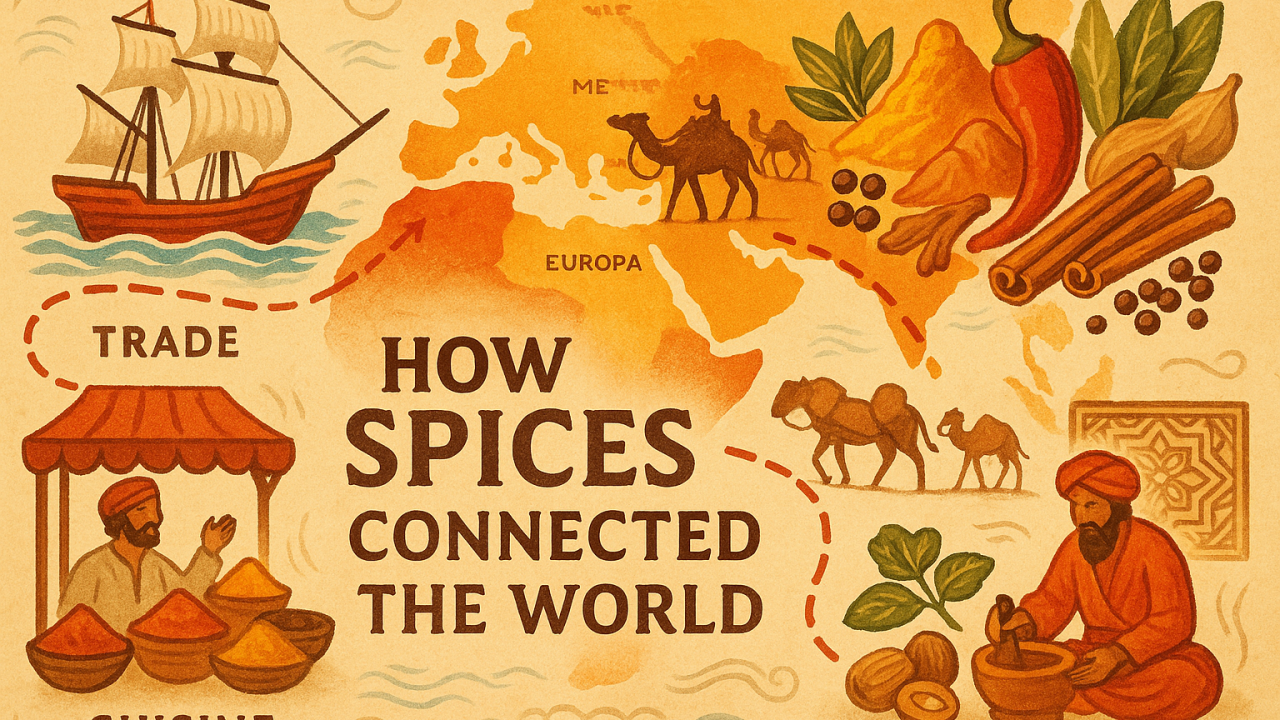
Long before the Silk Road, maritime trade networks carried spices across Asia. A historical survey notes that spice routes were established around 3000 BCE, about two millennia earlier than the Silk Road . Cinnamon, pepper, ginger, cloves and nutmeg were traded along these routes and were initially valued as medicinal plants; their use as culinary flavourings came later . The routes linked the East and West across some 15,000 kilometres, stretching from Japan and Indonesia through India and the Middle East to Europe . With India producing an estimated 70 % of the world’s spices , the subcontinent became the centre of this trade. For nearly 5,000 years Arab traders dominated the network until European powers began searching for direct sea routes .
The maritime aspect of the spice trade was pioneered by Austronesian sailors from Southeast Asia, who established routes to Sri Lanka and India as early as 1500 BC . Their ships transported cinnamon, cassia and other aromatics to the Mediterranean via Indian and Persian traders . This network later expanded to the Red Sea and East African coast, eventually reaching Madagascar . These voyages were not solely commercial – the Austronesians introduced new shipbuilding technologies such as plank‑sewn hulls and outrigger boats; their languages even influenced maritime terms in Tamil, Telugu and Kannada . They also carried bananas, coconuts, ginger and sugarcane to India and Africa , demonstrating how spice commerce fostered cultural diffusion.
Spices, status and the European Age of Exploration
By the Middle Ages spices were treasured luxuries in Europe. The World History Encyclopedia explains that European demand for pepper, ginger, cloves, nutmeg, mace, cinnamon and saffron fuelled the search for direct access to Eastern suppliers . In the 15th century Portugal’s Vasco da Gama rounded the Cape of Good Hope and reached India, opening the sea route that allowed European powers to compete in the spice trade . Once spices reached Europe they were used not to disguise spoiled meat – as folklore claims – but to add flavour and to showcase wealth . Royal households consumed huge quantities; records show the Duke of Buckingham’s home using about two pounds (900 g) of spice per day in the 15th century .
The high value of spices is illustrated by remarkable episodes. A 2018 historical survey recounts that London dockworkers received bonuses in cloves and that when the Visigoths captured Rome in 410 AD they demanded3,000 pounds of peppercorns as ransom . Venice monopolised the European spice trade in the 13th century and amassed enormous wealth through high tariffs . Vasco da Gama’s 1498 voyage allowed Portugal to dominate the route temporarily until the Dutch, and later the British East India Company, took control .
Cultural diffusion along the spice routes
Trade was never just about commodities; it carried ideas, religions and technologies. Austronesian sailors transferred shipbuilding techniques and introduced new crops, while Indian, Persian and Arab merchants transported Persian and Arabic languages and Sufi Islam to the Indian subcontinent . Later, Portuguese colonial settlements along the coasts of India attracted Gujarati, Chetti, Syrian Christian, Chinese and Arab traders . Cultural borrowing flowed in both directions. Indian cuisine, transported by merchants, took hold in Southeast Asia , while Southeast Asian rice cakes and coconut‑milk dishes were adopted in India and Sri Lanka . European colonisers brought baking and new ingredients to India, giving rise to fusion dishes such as vindaloo and Anglo‑Indian curry .
The Raw Spice Bar blog describes how the ancient Spice Routes connected East and West, allowing merchants to carry Indian black pepper, Ceylonese cinnamon and Moluccan nutmeg across Asia and the Middle East to Europe . TheSilk Road served as a culinary highway where noodles travelled from China to Italy and Middle Eastern techniques influenced both directions . Romans used Eastern spices to display wealth and sophistication . During the Columbian Exchange European ships returning from the Americas introduced tomatoes, potatoes, corn and chili peppers to Eurasia . Conversely, European staples like wheat and dairy transformed diets in India, Vietnam and other colonies, creating new hybrid cuisines .
How cuisines use spices differently
Despite their shared origins, spices evolve new identities in different cultural contexts. The Spruce Eats notes thatcardamom is widely used in Indian, Middle Eastern, Arabic and Swedish cuisine . In India cardamom pods perfume basmati rice, curries and masala chai, while in the Middle East ground cardamom flavours desserts and Turkish coffee . Scandinavian bakers incorporate green cardamom into breads and pastries such as kanelbullar, giving the spice a sweet, aromatic character. The same ingredient thus takes on very different roles: savoury in South Asia, sweet in Northern Europe. Green cardamom is common in Nordic and Middle Eastern cooking whereas black cardamom, with its smoky flavour, is favoured in Indian savoury dishes .
Spices also travel beyond their geographic origins. Cumin, once native to the Mediterranean and Central Asia, is now essential to Indian curries, Middle Eastern hummus and Latin American chilli con carne. Turmeric lends its golden hue to South Asian and Middle Eastern dishes and has recently become popular in Western wellness drinks. Cinnamon sweetens European pastries yet seasons savoury stews in North Africa and Mexico. Each culture adapts spices to local tastes, reinforcing identity while participating in a global culinary conversation.
Spices as heritage and identity
The interplay between food, place and memory gives culinary traditions deep cultural significance. UNESCO’sMediterranean Diet dossier describes the diet as a social practice that encompasses knowledge of cultivation, harvesting, processing and communal consumption . Seven emblematic communities across Cyprus, Croatia, Spain, Greece, Italy, Morocco and Portugal safeguard this heritage . Although not centred on spices alone, the recognition underscores how everyday ingredients and traditional methods form part of humanity’s intangible cultural heritage. Similar recognition has been granted to other foodways, such as Mexican cuisine and Turkish coffee, highlighting how culinary practices – and the spices that flavour them – embody collective identity.
Conclusion: A continuing story of connection
From prehistoric foragers discovering flavour to medieval merchants braving storms and deserts, spices have always been catalysts of connection. They inspired the earliest global trade networks, spurred voyages that reshaped world history, and carried languages, religions and technologies across continents. In kitchens around the world today, the same spice can take on radically different characters, reflecting local tastes while reminding us of our shared heritage. As a leading exporter of Indian spices, Krishach Industries Pvt Ltd continues this story – delivering the flavours of India to tables across the globe and participating in a tradition that has connected people for thousands of years. By appreciating the history and cultural significance of spices, we honour the diverse communities that have cultivated, traded and cooked with them and celebrate the rich tapestry of human experience they represent.